
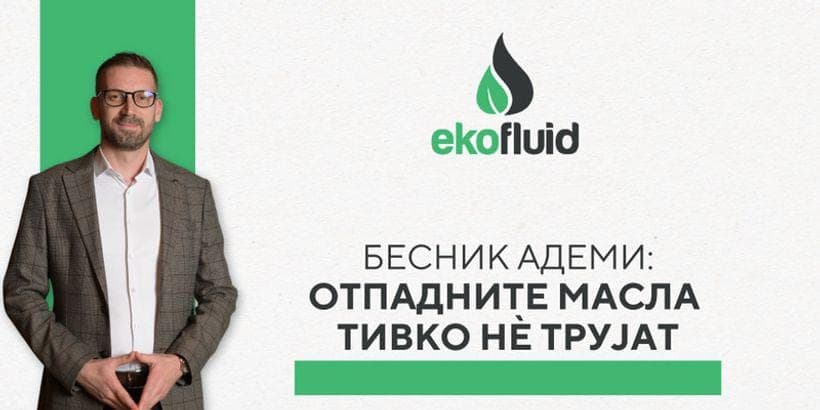
EKO-FLUID: Waste oils are silently poisoning us – why managing this hazardous waste is a legal, environmental, and health obligation
Interview with Director Besnik Ademi
Interview with Director Besnik Ademi
Waste oils are not an ordinary industrial residue that can simply be disposed of or “disappear”. They are hazardous waste, strictly defined and regulated by law, precisely because of the serious risks they pose if not properly managed.
When waste oils do not enter a controlled system, they end up where they cause the most damage – in the soil, in water, and in the air we breathe.
Although a legal framework exists in Macedonia, in practice there are still cases where some waste oils end up in sewage systems, on land, in riverbeds or, particularly concerning, are used for heating during the winter months. The consequences of such practices are not only environmental, but also directly linked to public health.
“Waste oil does not disappear if it is spilled or burned. On the contrary, it becomes even more dangerous – for the environment and human health,” says Besnik Ademi.
To understand what proper, legal, and professional management of waste oils should look like, we spoke with him as Director of EKO-FLUID, the first licensed collective operator for oil and waste oil management in Macedonia.
Waste oil as a legal obligation, not a personal choice
The moment motor, industrial, or hydraulic oil completes its primary purpose, it becomes waste. From that moment on, its handling is not a matter of choice, but a legal obligation.
“Managing waste oils is not a recommendation, but a clearly defined obligation that exists to protect the environment and public health,” explains Ademi.
The law stipulates that the collection, transport, and treatment of waste oils must be carried out exclusively through licensed entities, under constant supervision and with clearly defined procedures. Any deviation from this system opens the door to pollution, misuse, and long-term consequences.
How does the licensed and professional system function?
Professional management of waste oils is not limited to simply “collecting” them. It is a fully organized and controlled process that begins at the point where the waste oil is generated and ends with its safe treatment.
Waste oils are collected from authorized auto repair shops, industrial facilities, and other entities that use them in their operations. The collection is performed by licensed collectors with appropriate equipment and documentation, after which the oils are transported to authorized facilities for storage, treatment, or recycling.
“Every quantity of waste oil must be fully traceable – from the moment it is generated to the moment it is safely treated. That is the essence of the licensed system,” emphasizes Ademi.
Where do problems most often arise?
Despite the existence of clear regulations, in practice problems most often arise from:
insufficient awareness of legal obligations
misconceptions that waste oil management is an additional cost
or deliberate avoidance of responsibilities
In such situations, waste oils are often handed over to unauthorized individuals or used for heating without any control or documentation.
“The short-term savings that someone thinks they are making actually create long-term damage – to the air, health, and society as a whole,” Ademi points out.
Burning waste oils and its impact on air quality
One of the most serious problems is the uncontrolled burning of waste oils. These oils contain heavy metals and toxic compounds that, when burned under improper conditions, are directly released into the air.
“What some see as cheap heating is in reality a direct threat to public health,” warns the Director of EKO-FLUID.
Such emissions contribute to increased PM particles and the presence of carcinogenic substances, with long-term consequences, especially for children, the elderly, and people with chronic illnesses.
Where in the world does this work best?
Germany, Sweden, the Netherlands, Austria, and Japan are often cited as positive examples in waste oil management. What these countries have in common is strict regulation, a high level of institutional oversight, and strong public awareness of the dangers of improper handling.
“These systems show that when the rules are clear and respected, the results are cleaner air and lower health risks,” says Ademi.
Message to citizens
Although economic challenges are real, using waste oils for heating or disposing of them improperly represents a serious risk.
“Every citizen who chooses to hand over waste oil to a licensed system, instead of burning or dumping it, directly contributes to cleaner air and better public health,” Ademi states.
How can companies get in touch and who is part of the system?
Companies that produce or import motor and industrial oils can contact EKO-FLUID through the official website, as well as via direct communication by email or phone. The goal is to clearly explain legal obligations and provide an appropriate model for inclusion in the licensed system.
Today, the EKO-FLUID system includes 110 member companies, including domestic and international oil producers and importers, trade systems, industrial manufacturers, and companies from the automotive industry.
Conclusion
Waste oil management is not a bureaucratic formality.
It is a legal obligation, a professional standard, and a matter of public health.
“Proper waste oil management is not a cost – it is an investment in health, the environment, and the future,” concludes Ademi.